

Transcritical CO2 System Market is expected to reach USD 16,650 Million by 2035, growing from USD 3,400 Million in 2026
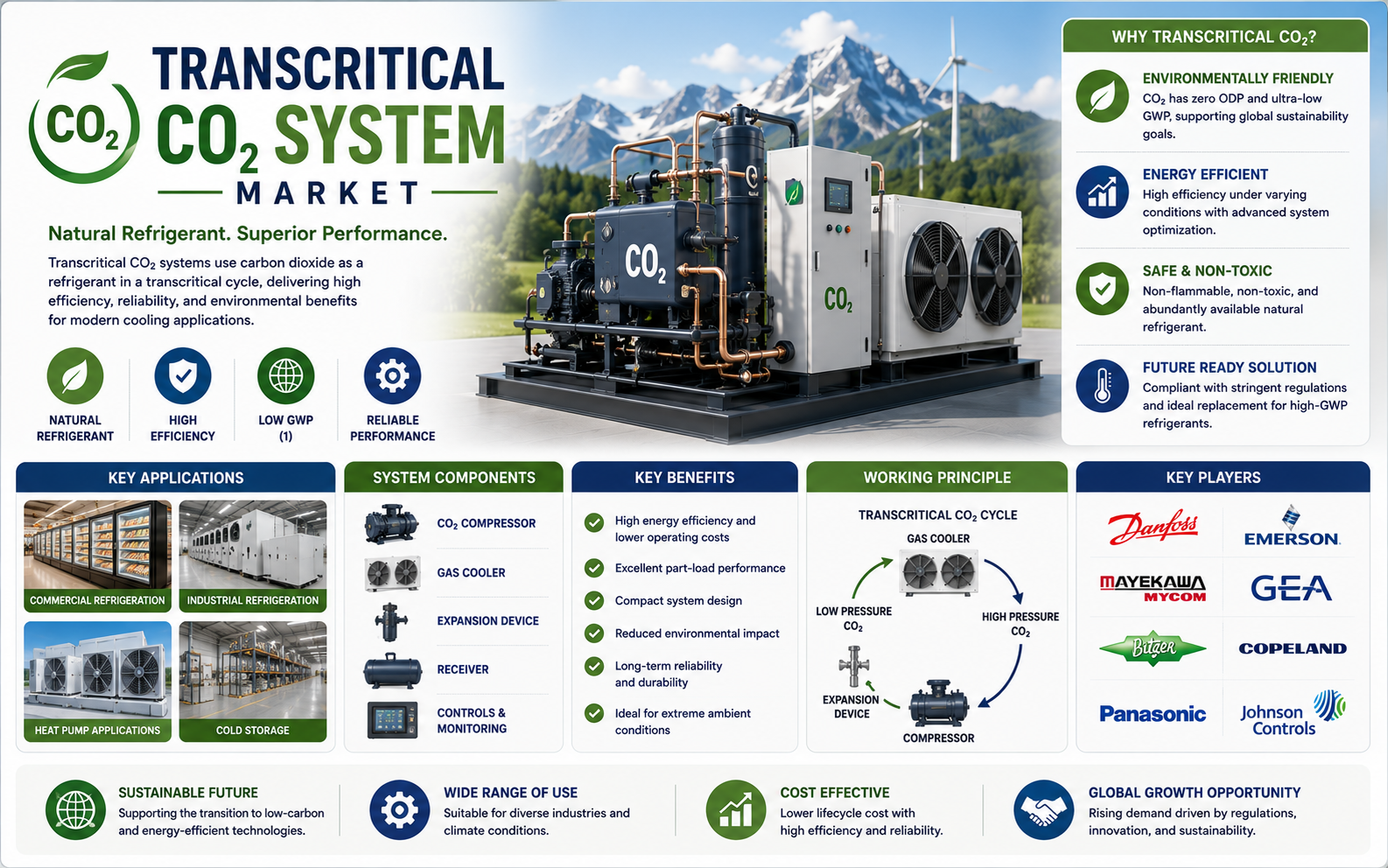
Transcritical Co2 System Market (2026 - 2035)
North America recorded a 19.8% CAGR from 2026 to 2035, propelled by federal incentive programs and state mandates.
GA, UNITED STATES, July 29, 2026 /EINPresswire.com/ -- The transcritical CO2 system market reached a valuation of USD 2,850 million in 2025 and is projected to grow from USD 3,400 million in 2026 to approximately USD 16,650 million by 2035, representing a compound annual growth rate of 19.3% across the 2026–2035 forecast period. This is one of the more sharply accelerating niches within industrial refrigeration, driven by a convergence of regulatory pressure and improving system economics.The primary catalyst is Europe's F-Gas Regulation phase-down schedule, which has cut hydrofluorocarbon quotas by more than 40% since 2024, alongside parallel policy momentum building across North America and parts of Asia-Pacific. Capital commitments from grocery chains and cold-storage operators — many exceeding USD 200 million per retailer — further reinforce the financial case for switching to transcritical CO2 systems.
A broader technology transition underlies this growth. Legacy HFC-based direct-expansion systems, long the default choice for supermarkets and distribution centers, are being displaced by global transcritical CO2 architectures that combine ejector technology, parallel compression, and adiabatic gas cooling. These enhancements have narrowed the energy-cost gap even in high-ambient climates, a shift validated by pilot deployments across the Middle East and Southeast Asia where temperatures routinely exceed 40°C. The emergence of high-temperature heat pumps capable of delivering outlet temperatures above 120°C has also opened new process-heat revenue streams, extending the market well beyond traditional refrigeration use cases.
Europe holds a dominant position, accounting for roughly 71.8% of global revenues in 2025, a lead built on regulatory head-start and dense supermarket infrastructure. It's also the fastest-growing region, expanding at a 19.8% CAGR through 2035. North America ranks second, supported by EPA rule amendments and state-level HFC bans in California, New York, and Washington.
Download Report Sample Copy: https://www.marketresearchfuture.com/sample_request/30554
Market Segmentation
By Component
Compressors represented the largest component segment, holding 37.2% of market revenue in 2025, reflecting heavy investment in semi-hermetic and reciprocating compressor platforms. Bitzer, Dorin, and Emerson command significant share here through proprietary systems rated for pressures above 130 bar. Gas coolers are the fastest-growing component, expanding at a 20.0% CAGR through 2035 as adiabatic and hybrid designs gain traction — these use a fine mist spray on heat-exchange surfaces during peak ambient conditions, extending transcritical systems' viability into climates once served exclusively by HFC-based units. Other components, including valves, controllers, ejectors, and piping, contributed roughly USD 790 million in 2025.
By Function
Refrigeration is by far the dominant function, capturing 72.4% of the market in 2025, led by supermarket rack systems and cold-storage build-outs. Medium- and low-temperature parallel racks form the backbone of most supermarket and warehouse installations globally. Heating applications, while smaller today, are projected to grow fastest at a 20.4% CAGR through 2035, fueled by high-temperature heat-pump adoption in food processing as industrial operators replace natural-gas boilers under tightening carbon-pricing regimes. Other functions, covering combined heating-cooling integrated systems, contributed about USD 95 million in 2025.
By Installation Type
New-build installations dominate, holding 79.8% share in 2025, since designing a store or warehouse around a high-pressure CO2 system from the outset avoids costly structural retrofitting. Retrofit installations are the faster-growing category, expanding at a 20.7% CAGR through 2035 as F-Gas deadlines and Kigali Amendment obligations force existing facilities to convert aging HFC systems.
By Application
Supermarkets are the leading application, with a 68.8% share in 2025, propelled by retailer sustainability pledges and accelerating retrofit activity tied to regulatory compliance. Industrial refrigeration is the fastest-growing application at a 19.6% CAGR through 2035, supporting expanding blast-freezing and cold-storage logistics operations. Other applications, including data centers and pharmaceutical cold-chain use cases, contributed roughly USD 120 million in 2025.
By End-User Industry
Food retail is the anchor end-user vertical, holding 60.5% share in 2025, as the world's largest supermarket chains publicly commit to fully low-GWP refrigerant fleets by 2030. Food and beverage manufacturing contributed about USD 430 million in 2025, driven by process-heat decarbonization mandates. Logistics and warehousing is the fastest-growing end-user segment at a 20.2% CAGR through 2035, propelled by the growth of online grocery and last-mile cold delivery. Other industries — pharmaceutical, chemical, and data-center cooling — are growing at a comparable 17.8% CAGR.
Buy Now: https://www.marketresearchfuture.com/checkout?currency=one_user-USD&report_id=30554
Regional Market Analysis
Europe commands the largest regional share at 71.8% in 2025, anchored by two decades of regulatory precedent dating back to Denmark's pioneering HFC taxes in 2001, culminating in the current F-Gas Regulation's target of an 85% HFC quota cut by 2036. Within Europe, Germany holds the largest share of regional revenue at 22.3%, backed by the continent's largest installed base and strong energy-efficiency incentives. The UK is growing fastest within the region at an 18.7% CAGR, driven by net-zero pledges from major grocers like Tesco and Sainsbury. France contributed about USD 215 million in 2025, tied to Carrefour's fleet conversion and Loi Climat mandates, while Italy holds 14.8% of regional share as home to manufacturing hubs like SCM Frigo and Arneg. Spain is expanding at 19.2% CAGR on the back of Mercadona's new-store rollout, the Nordic countries contributed about USD 195 million reflecting early-adopter maturity and district-heating integration, Russia holds a modest 2.1% share tied to import-substitution policy, and the rest of Europe is growing at 18.5% CAGR as Eastern European cold-chain infrastructure modernizes.
North America is the second-largest region, growing at a 19.8% CAGR through 2035. Within it, the US accounts for 68.4% of regional share, driven by EPA SNAP listings and California's CARB HFC rules; major grocery chains including Whole Foods, Sprouts, and Aldi have committed to deploying transcritical CO2 in all new stores. Canada is growing at 19.5% CAGR, supported by federal carbon pricing and fleet rollouts from Loblaw and Metro, while Mexico contributed roughly USD 28 million, tied to SEMARNAT regulations and export-oriented cold-chain needs.
Asia-Pacific, valued at about USD 280 million in 2025, represents the highest long-term growth potential in the market, though adoption today remains constrained by technician availability and ambient-temperature concerns. China holds the largest share within the region at 31.5%, backed by government green-cooling subsidies and its 14th Five-Year Cold Chain Plan, which has earmarked CNY 50 billion for upgrading perishable logistics infrastructure. India is growing fastest at a 20.6% CAGR, driven by Kigali Amendment compliance and organized retail expansion. Japan, valued at roughly USD 62 million, has led regional deployment with over 300 transcritical installations by 2024, supported by its revised High Pressure Gas Safety Act and convenience-store pilot programs. South Korea is growing at 19.4% CAGR under its K-F-Gas Act and semiconductor cleanroom cooling trials, ASEAN holds 12.8% of regional share on food-export quality mandates and ADB financing, and the rest of Asia-Pacific is growing at 18.9% CAGR as regulatory frameworks emerge.
South America remains a smaller market, holding 2.8% of global share in 2025. Brazil anchors the region with 58.2% of regional share, as major meat and poultry exporters like JBS and BRF invest in CO2-based blast-freezing systems to satisfy EU import sustainability requirements. Argentina is growing at 19.0% CAGR on dairy-processing modernization, while the rest of South America contributed roughly USD 14 million, supported by multilateral financing for Kigali compliance.
The Middle East and Africa region is growing fastest of all at an 18.1% CAGR through 2035, having shifted from skeptic to early adopter after successful adiabatic gas-cooler installations proved viable in ambient temperatures exceeding 48°C. Saudi Arabia leads with 28.4% of regional share, tied to Vision 2030 food-security investments. The UAE is growing at 20.3% CAGR, driven by LULU and Carrefour Middle East store rollouts and adiabatic cooling validation projects. South Africa, valued at roughly USD 6 million, is seeing pilot deployments from Shoprite and Pick n Pay, Egypt is growing at 19.1% CAGR tied to Suez Canal cold-corridor logistics, and the rest of the region holds 3.5% share amid a still-nascent regulatory landscape.
Report Summary: https://www.marketresearchfuture.com/reports/transcritical-co2-system-market-30554
Growth Drivers
The EU F-Gas Regulation phase-down is the single largest growth driver, estimated to contribute around 22% of overall CAGR, concentrated in Europe over the short term. The revised regulation mandates an 85% reduction in HFC quotas by 2036 relative to the 2015 baseline, and quota pricing for HFC-404A has already tripled since 2022, tilting the lifecycle cost equation firmly toward CO2-based alternatives. Retailers in Germany, France, and the Nordic countries face compliance deadlines as early as 2025 for systems exceeding 40 kW.
Kigali Amendment obligations under the Montreal Protocol, ratified by over 150 nations, contribute an estimated 18% of CAGR globally over the medium term, requiring developed countries to cut HFC consumption by 85% by 2036, with developing-nation obligations phasing in from 2028. The International Energy Agency estimates full compliance could avoid up to 0.5°C of global warming by 2100.
Ejector and parallel compression cost reductions contribute roughly 16% of CAGR globally over the short term. Field data from installations in southern Italy, Spain, and the UAE show multi-ejector modules have cut the energy penalty of transcritical operation in temperate climates by 15–25%, while standardization by manufacturers like Carrier and Danfoss has driven a 30% reduction in component costs since 2021.
High-temperature heat-pump expansion adds an estimated 14% to CAGR across Europe and Asia-Pacific over the medium term. CO2 heat pumps delivering water temperatures above 120°C are unlocking industrial process-heat applications in food processing, brewing, and dairy pasteurization, and the European Commission's REPowerEU plan earmarked EUR 12 billion for heat-pump deployment between 2023 and 2027, with a sizable share targeting industrial-grade CO2 units.
State-level HFC bans in the US contribute about 12% of CAGR in North America over the short term, while cold-chain expansion in emerging economies across Asia-Pacific and South America adds roughly 10% over the long term. ESG disclosure mandates tied to Scope 3 emissions reporting round out the driver set, contributing an estimated 8% of CAGR globally over the long term.
Future Outlook
AI-optimized system controls are expected to reduce annual energy consumption by 10–18% by dynamically adjusting compressor staging, ejector activation, and gas-cooler fan speed in response to real-time conditions. The IEA anticipates that by 2030, over 60% of new transcritical installations will include embedded AI control modules.
Electrification and grid-interactive refrigeration are also poised to reshape the market, as CO2 refrigeration racks are increasingly integrated with on-site solar PV, battery storage, and demand-response programs — effectively turning cold stores into virtual power plants that can shift compressor loads to off-peak hours or curtail demand during price spikes.
Platform economics and servitization will likely accelerate further, with equipment OEMs bundling hardware, monitoring software, and maintenance into subscription contracts that align incentives around uptime and lower adoption barriers for cost-sensitive buyers. Meanwhile, ESG reporting requirements under frameworks like the EU's Corporate Sustainability Reporting Directive and the US SEC's climate disclosure rule are compelling companies to quantify and reduce Scope 3 refrigerant emissions — and because CO2 carries a global warming potential of 1, compared to 3,922 for HFC-404A, switching to transcritical systems delivers an immediate, verifiable emissions reduction that functions as a pull factor largely independent of energy-cost savings.
Competitive Landscape
The market shows moderate concentration, with the top five players accounting for an estimated 48–55% of global revenue and a Herfindahl-Hirschman Index in the 800–1,200 range — competitive but not fragmented. Differentiation centers on compressor technology, warm-climate system optimization, and digital-monitoring integration.
Carrier Global Corporation leads with an estimated 12–15% revenue share, positioned as a full-system OEM with a global service network built around its CO2OLtec transcritical racks. Hussmann Corporation, part of Panasonic, holds roughly 10–13% share with its Protocol-series systems and strong North American supermarket presence. Hillphoenix, under Dover Corporation, holds about 9–12% share through its Advansor-designed transcritical booster racks and vertically integrated compressor-to-rack platform. Bitzer SE holds an estimated 7–10% as a compressor specialist known for its ECOLINE+ semi-hermetic CO2 compressors and OEM supply partnerships. Dorin S.p.A. holds roughly 5–8% with its Italian-engineered, export-driven CD-series compressors, while Danfoss A/S holds about 5–7% as a component leader known for multi-ejector modules and electronic expansion valves.
Emerson Electric Co. holds an estimated 4–6% share through its Copeland CO2 scroll compressors and Lumity digital monitoring platform. SCM Frigo S.p.A. holds roughly 3–5% as a Southern European manufacturing hub, Carnot Refrigeration holds about 2–4% as a Canadian specialist in compact, modular transcritical condensing units, and GEA Group AG rounds out the top ten with an estimated 2–4% share focused on industrial-scale CO2 refrigeration and heat pumps.
Related Report
Pharmaceutical Desiccants Market https://www.marketresearchfuture.com/reports/pharmaceutical-desiccant-market-4182
Pulp & Paper Chemicals Market https://www.marketresearchfuture.com/reports/pulp-paper-chemicals-market-6932
Titanium Metal Market https://www.marketresearchfuture.com/reports/titanium-metal-market-7482
Steel Fabrication Market https://www.marketresearchfuture.com/reports/steel-fabrication-market-10929
de icing agents market https://www.marketresearchfuture.com/reports/de-icing-agents-market-28181
dissolvable frac plug market https://www.marketresearchfuture.com/reports/dissolvable-frac-plug-market-25709
expanded clay market https://www.marketresearchfuture.com/reports/expanded-clay-market-32120
Market Research Future
Market Research Future
+ +1 855-661-4441
email us here
Legal Disclaimer:
EIN Presswire provides this news content "as is" without warranty of any kind. We do not accept any responsibility or liability for the accuracy, content, images, videos, licenses, completeness, legality, or reliability of the information contained in this article. If you have any complaints or copyright issues related to this article, kindly contact the author above.
